
How do I know if I have dementia?
September 10 2024 | Last Updated: Feb 5 2025
This content is provided for general education and information only. It does not provide individualized medical advice, diagnosis, or treatment, and does not establish a doctor–patient relationship. Always seek the advice of your own physician or qualified healthcare provider regarding personal medical decisions.
Table of Contents
Knowing whether someone has dementia can feel confusing.
How do you tell the difference between normal, and a medical condition?
In this article we’ll talk about the 5 things that can suggest that someone is experiencing dementia, rather than the natural changes of aging.
This article cannot diagnose dementia. The goal is to introduce you to important parts of the medical story, so that when you see your own healthcare provider for advice you’re prepared for what they might ask.
#1 What’s your story?
Just like with any other medical condition, memory changes have a particular story that go with them.
For example, if you broke your foot it might go like this: “I fell down and now I can’t walk without it hurting”.
When it comes to memory, we can think of the story as unfolding gradually along a spectrum, which each of the following sections explore.

Memory changes gradually along a spectrum from normal aging, to pre-dementia, to dementia.
Normal aging
Normal aging sounds like:
occasionally struggling to come up with a word you want
more difficulty with multitasking
taking longer to recall information, process new information, or get your thoughts together
Despite these changes, most of your friends and family haven’t found you to be “overly” forgetful (they aren’t worried about it), and when doctors do a memory test with you, your score is normal.

Anne would fall in to the category of “normal aging”.
Pre-Dementia
Pre-dementia, known to doctors as “Mild Cognitive Impairment”, or MCI, is when changes to memory or thinking are becoming more obvious to those around you.
This can sound like:
Repeating yourself in conversations
Asking the same question over and over again
Misplacing items around the house
Forgetting upcoming events such as doctor’s appointments
Forgetting recent events that have happened
Getting lost in familiar places
Changes to your personality
Poor judgement, insight, or decision-making
People around you are starting to get concerned. When doctors do a memory test with you, your score is lower than it should be.

Winnie has pre-dementia, or “Mild Cognitive Impairment”
Dementia
Changes progress to dementia when other people are needing to step in and help with daily tasks.
This might look like:
Trouble remembering to take your medications
Confusion with your bills and taxes
Having difficulty driving safely
Having trouble making meals
Needing someone else to get your groceries
When doctors do a memory test with you, your score is, again, lower than it should be.

Sharon has moderate dementia.
#2 Memory Testing
Memory testing is necessary for telling normal aging and pre-dementia (MCI) apart.
Normal aging will have a normal score.
Pre-dementia will have a score that is lower than it should be for your age and educational background.
Right now, healthcare providers mainly use two different pen-and-paper tests in Canada, called the “MoCA” (pronounced Moh-Kah) or “MMSE” (pronounced as its individual letters, M-M-S-E).
IMPORTANT: getting a low score on it’s own without any reported problems with memory can be normal if you didn’t do a lot of tests growing up (for example if you completed only elementary school).

It’s not just about the score - it’s about what changes you or family have noticed in your day-to-day life.
#3 Daily Life
Needing help in your daily life is what tells pre-dementia (MCI) and dementia apart.
If you are coping on your own with memory tools (like lists, reminders, etc), this is suggestive of pre-dementia
If you are needing help from others, this is suggestive of dementia
Doctors will ask you questions about the 7 daily tasks shown in the diagram below. If you’re needing help because of changes to your memory or thinking, then this is suggestive of dementia.
IMPORTANT: If you’re needing help because physically you can’t do the tasks (such as being too tired, or having difficulties with balance), then this does not mean you have dementia, simply because you need help. It must be due to cognitive changes.
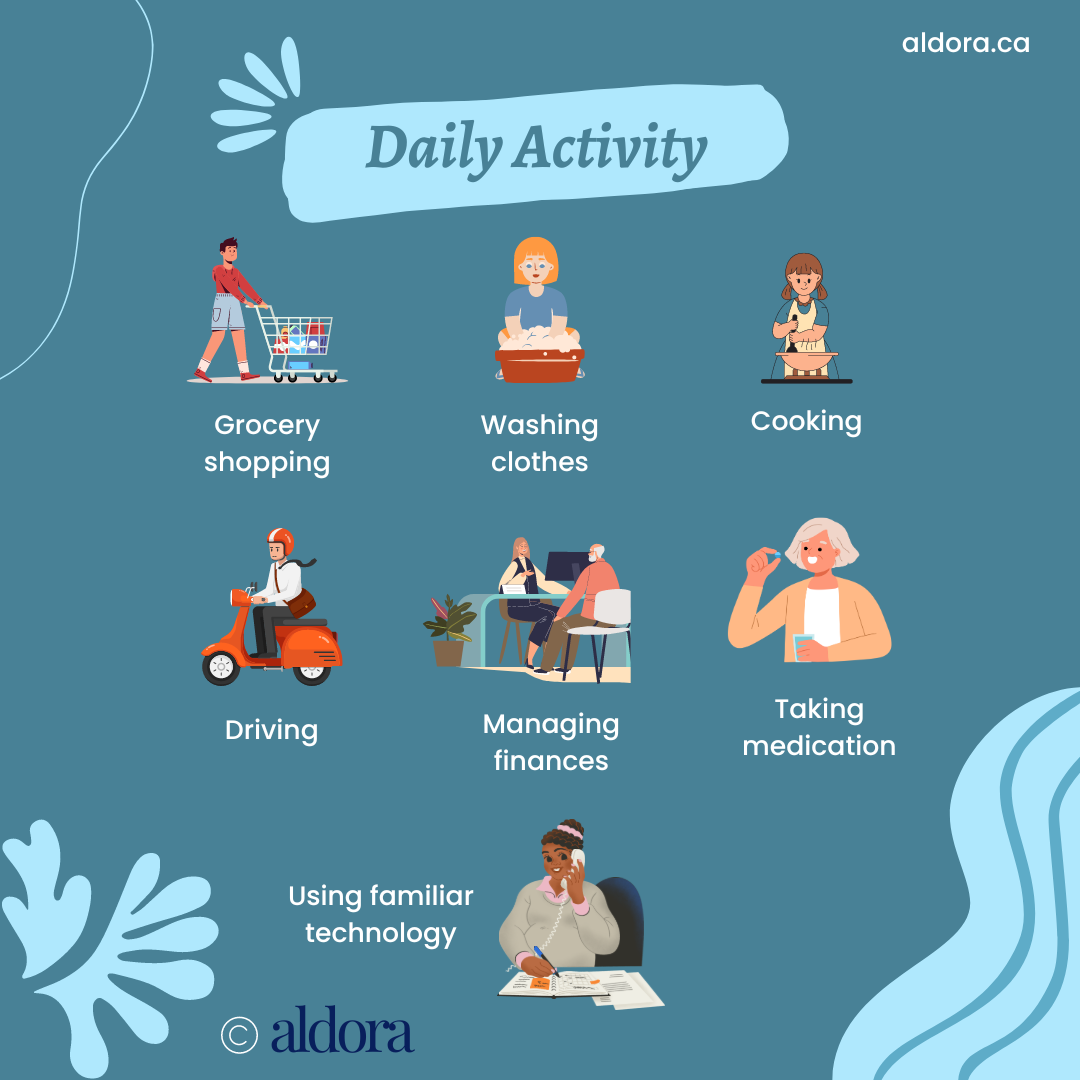
Things we do in daily life that become impacted by memory problems include: grocery shopping, laundry, cooking, driving, managing finances, taking medications, and using technology such as the phone or computer.
#4 Reversible Causes
Whether you have normal aging, mild memory problems, or dementia, it is very important that we spend time looking for and fixing any reversible causes.
You can find detailed guides to all of the following at Aldora, but in brief:
A doctor should examine you.
Your doctor should do what’s called a “neurologic physical exam” - testing your strength, your nerves, your balance, coordination, and stiffness. Any changes they see should prompt them to order a CT scan of the brain to see if something else is going on, and possibly send you to see a neurologist or geriatrician.
You need some routine Blood Work
Your doctor should order tests for reversible medical conditions that can cause memory problems.
Ask your doctor to check:
CBC, electrolytes, creatinine
Calcium, albumin
TSH, B12
HbA1C (for diabetes)
Other special tests if you are less than 65 or have an unusual story (ask your doctor)
If any of these tests are very abnormal, your doctor should work with you to bring them back into a normal range.
However, if any of these tests are just slightly abnormal, they probably aren’t the cause of your changes to memory. You can still work with your doctor to bring them back into a normal range for good health, but they aren’t enough to explain your symptoms.
Review your situation for preventable causes:
As we discuss in this article, 45% of dementia is preventable if certain every-day problems are caught early and fixed.
These include things like alcohol use, depression, hearing problems, head injuries, medications with memory side effects, etc.
Even in those with MCI, 25-40% of people can improve their symptoms with steps outlined in this article.
What about Medications?
You do not need medication for pre-dementia, as of right now in Canada. If you live in the USA, you might be eligible for new medications, although these come with risks at the moment.
#5 Yearly check-ins with your doctor
How often do you need to see your doctor if you have concerns about your memory?
Normal Aging
Only when you need them.
You only need to see your doctor if you or your family notice new or concerning changes to your memory or thinking.

Check in with your doctor or nurse practitioner if you notice changes to your memory or thinking.
Pre-dementia
Every year.
If you have pre-dementia or mild cognitive impairment (MCI), you should see your doctor once a year to repeat testing and review your symptoms.
If your symptoms progress to the point of needing help with daily tasks then you might want to book an earlier appointment to review and ask whether any new medications are now available.
If you are working on fixing preventable causes (such as high blood pressure, diabetes, etc), you might need to see your doctor more often to get these targets under control.
Throughout this time, make sure you are addressing all of your preventable risk factors for dementia with Aldora (or another place you like to get your health information).

Check in with your doctor once a year to monitor your memory and ensure you've managed all preventable and reversible causes of your symptoms.
Dementia
Every 6-12 months, or more frequently if you need them.
If at any time you or your loved one struggles with hallucinations, odd behaviours, wandering away from home, etc, you should see your doctor and likely a specialist, like a geriatrician or geriatric psychiatrist, as soon as you notice these changes. There are medications that can help.

Set regular appointments with your doctor or nurse practitioner to review any changes to your thinking, behaviour, or daily activities.
In closing…
You now have a roadmap for what to expect when seeing your doctor or nurse practitioner for memory problems.
What’s next?
Book an appointment with your healthcare provider to obtain a proper diagnosis.
Learn to optimize your brain health with Aldora.
You can also join your local Alzheimers Society FirstLink program, which helps you navigate community resources for brain health and dementia. You do not need to wait for a physician referral to get their help - sign up today.
Related Posts



Disclaimer: The content on Aldora Health is for educational and informational purposes only and is not intended to substitute for professional medical advice, diagnosis, or treatment. Always seek the advice of your physician or other qualified health provider with any questions you may have regarding a medical condition. For more read our Terms of Use.